
In the late 20th and early 21st century Vegetarianism and Veganism have become global ways to combat climate change and reduce your carbon footprint. Communities and movements have formed in more recent years as Veganism has become mainstream and trendy. The Vegan Society state ” The number of vegans in Great Britain quadrupled between 2014 and 2019. In 2019 there were 600,000 vegans, or 1.16% of the population; 276,000 (0.46%) in 2016; and 150,000 (0.25%) in 2014. Sources: Ipsos “. As we can see Veganism is on the rise, with it’s views becoming more mainstream; however, they still only count for just 1.1% of the British population (numbers of vegetarians vary between 5.7 million and 9 million) so let’s analyse some of the mainstream food trends of vegans.
Veganuary: A Closer Look
During the month of January the non-profit organisation Veganuary has been leading the campaign to encourage more people into trying veganism for a month, and then stick with it. They give education, advice and recipe’s to those taking the challenge. Veganuary’s website states “our vision is a vegan world”, they go on to write
Our vision is simple; we want a vegan world. A world without animal farms and slaughterhouses. A world where food production does not decimate forests, pollute rivers and oceans, exacerbate climate change, and drive wild animal populations to extinction.
https://uk.veganuary.com/
On the surface, Veganuary and the Vegan movement appear to be providing a large counterbalance to climate change. In theory a Vegan diet reduces your carbon footprint, reduces demand for meat and reduces the effects of climate change. Many people have been attracted to Veganism and Vegetarianism due to these facts and this has actually had the inverse effect in many cases. First, let’s take a look at 3 specific cases where a change in diet isn’t doing the good that people think.
Avocados
Avocados are native and grown in South and Central America, specifically in Peru and Mexico and by the state of California. Avocados became one of the leading foods for Vegans as a plan alternative; this quickly took off and Avocados became fashionable and trendy, whilst being served in the vast amount of Vegan cafes popping up. Avocados, despite being grown abroad and transported to Europe, were considered by many the great alternative and thus demand for the fruit sky-rocketed; it is in fact because of this increase in demand that the sustainability and environmental benefits of choosing this food became under threat. Demand for the fruit first began to push farmers in Mexico to resort to deforestation, as farmers need wooden crates for shipping and needed to create more land for farms. A reported 690 hectares of forest was lost to illegal actions taken by farmers during the start of the boom from 2000-2010 (source: https://www.theguardian.com/lifeandstyle/2016/aug/10/avocado-illegal-deforestation-mexico-pine-forests) This article further states that Avocado farmers in Mexico were arrested for deforesting a 4.7 hectare plot to make room for 1,320 Avocado samplings in 2016, With these numbers reportedly increasing vastly in 2018 a very clear pattern emerges; with demand for a type of food, be it cattle in Brazil or Avocado in Mexico attempts will be put in place to increase production of said item, so if the whole world became Vegan and demand for Avocados increases, then there will be increased deforestation in Mexico and a decrease in Brazil. This, as far as these statistical trends are concerned, does not fit the Vegan message.
Another issue with the Avocado story surrounds money. The growth in demand for Avocados attracted Mexican drug cartels who forced local farmers to pay protection money or risk their farms being burnt and seized. These issues are affected greatly by rising trade and boarder tensions with the United States, as America makes up 77% of the global Avocado market (source: https://www.bloomberg.com/news/articles/2019-06-26/waiting-for-cheaper-avocados-don-t-hold-your-toast-for-it). The gain in money for Avocado farmers has also seen the increase in fertilisers used, this harms the natural ecosystems of local environment and due to water runoff can affect water supplies as well.
These two issues concluded in the sustainable cafe The Wild Strawberry in Buckinghamshire removing the fruit from its menu completely and a further in Bristol shortly following this.
However even with these actions Avocado remains popular within Vegan communities and this is shown by its commonplace on Veganuary’s suggested recipes. All of these aforementioned issues are placed on top of the pollution caused by transport of Avocados around the world; with these issues taken into consideration the argument used by The Wild Strawberry to chose instead local seasonal food would be more beneficial for the planet.
AlmondS
Almond has enjoyed the same success that Avocado has within the same communities in recent years. The Almond industry in California (which produces 80% of the global Almond market) has seen a 250% increase in sales over the last 5 years, with Almond orchards doubling from 500,000 to a million from 2000-2020. Source ( https://www.theguardian.com/environment/2020/jan/07/honeybees-deaths-almonds-hives-aoe). This a placed a strain on the natural essential for pollination of Almond, bees. Almond production requires a steady input from bees to function, and with the demand for Almond coming all year round, there was thus a demand for bees all year round despite bees needing to be dormant in the winter to keep them healthy. Bee keepers in America report they are experiencing an average loss of 38% of their colonies in 2019 with a loss of 30% experienced in California from 2018/19 (source: BeeInformed.org: https://beeinformed.org/citizen-science/loss-and-management-survey/). That is an estimated number of around 30-40 billion bees.
So why are the bees dying? The main contributing factor to their deaths is the pesticide industry in America. The lack of regulation on American farming practices means that it is often what vegans are trying to avoid; unsustainable, cruel to animals, and worse for the environment. The American almond industry most commonly uses a herbicide called glyphosate, more commonly known by the brand roundup, that is lethal to bees as well as a possible cause of cancer in humans (this is currently being debated in the US court system). This pesticide is not the only killer; demand for pollination causes the bees to become ill and these illnesses can spread rapidly amongst a hive. California’s unseasonable weather also greatly affects the bees, with flowers not blooming on time and bees waking up early to unbloomed flowers, their food source can become greatly depleted and cause starvation amongst the bees.
So with this information what do we learn? The trend of demand comes in to play again. When people increase a demand for a specific item this has adverse effects, and in this case greatly affected the bee population of California. The issue again seems to link back to an increase in demand for a product, directly increases the unsustainability. However the sustainability, it could be argued, comes not from what you consume but how we produce food, which is one of the original arguments for turning Vegan.
Quinoa
When discussing this article, a good friend of mine pointed out Quinoa as another ‘superfood’ that has become trendy in recent years. Quinoa’s initial impact on the environment was a tame self sustainable system of animal and crop farming in the high altitude Andes region where Llamas and Quinoa dominated the farming agenda. In recent years the demand, again, has changed the way Quinoa has been farmed. The first change, and perhaps the most impactful, was the local farmers decision to sell Llamas currently occupying fields in order to grow more Quinoa. This in turn led to the increase in bugs around the farms, thus increasing the use of pesticides (similar pesticides to that in America which kill bees). A lack of field rotation between Llama and crop has led to damaging soil erosion. The environmental impacts are a large negative, but what worsens this situation is the social aspect created by this new market. Quinoa has changed the diet of many Bolivians and Peruvians who farm Quinoa, as it was once a staple food in the region an increase in demand for the superfood has pushed prices higher and higher for local farmers and made it too expensive for the locals to buy. This market has pushed the locals to a diet containing more junk food as this has become cheaper. In both Bolivia and Peru Quinoa holds a place with the upper classes, whilst the farmers, in the majority of cases, have become poorer.
Overall, Quinoa lovers who are making a conscious effort have began buying Fairtrade or buying from Vegan sustainable farms, for example White Mountain Farm in Colorado. The website: https://www.onegreenplanet.org/ seems to have very well researched information on the up to date changes to the world surrounding veganism. https://www.onegreenplanet.org/environment/how-quinoa-is-shaping-monocultures-and-damaging-biodiversity/ provided useful information for this section.
A Summary
The effects of climate change do not simply stop by going Vegan, but in theory it helps change societal styles (the mass rearing of beef in Brazil for example) that will stop the production of Greenhouse gasses in the future. If we were to compare all diats on a scale where they ate the same sourced food it ends up looking like this
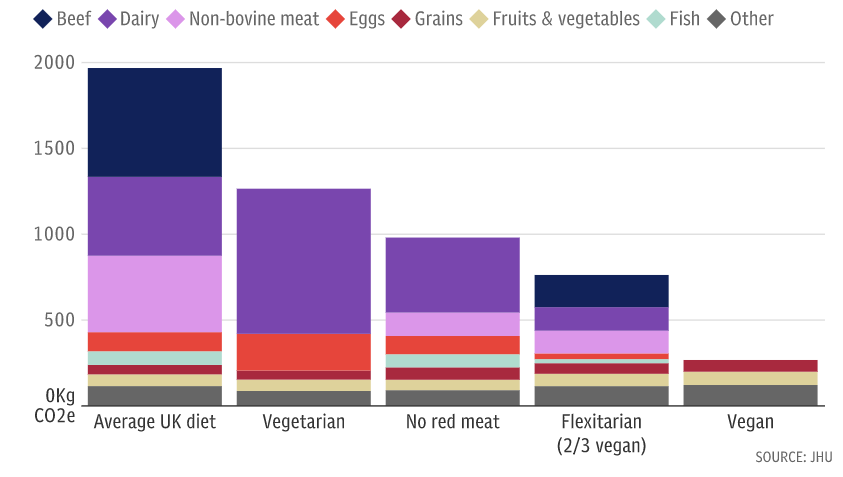
However in practise these numbers are taking into account the consummation of the same sourced food and therefore as we have seen can be unrealistic. This data requires people to eat local, sustainably sourced food. A seen by this article, that would be a perfect way to know that you are bettering the environment. One cannot simply drop meat from their diet and assume they are doing good, or choose veganism as a cool new trend, as these can be seen as having the adverse effect that anticipated. The argument to go vegan or not is still creating debate in the media, with conflicting information and old information still very much in the mainstream (articles on Quinoa for example were notably older than that of Almond). With so much of this topic based on opinion it’s important to know that research is key, reading conflicting articles helps you to pick out the facts from the emotive arguments.
The Opinion Section
Hopefully this article shows you guys a trend, a trend that suggest Sustainability comes not only from what we eat but also where we got it from and who made it. If you are concerned about the environment and want to change your diet and want to help make a change I would recommend buying local. British seasonal food is well sourced and the food miles are extremely limited. This will cost you more but will do double to help the environment and put money back into the local economy. There is more to this issue than meets the eye. With the current issues this world is facing a sustainable country will be hard to find if we continuously look abroad for food; to be sustainable your nation has to be self sufficient to a certain extent. The modern cheap supermarkets help individuals save money, but the nation as a whole loses out, so there is a larger issue to be had in that regard. At the end of the day research is the most important and with the world ever changing things that were once a good alternative may in fact become bad. I myself have no intention of becoming vegan or vegetarian as I believe in a balanced diet; I don’t eat meat all the time but i still eat it nonetheless.
Thank you for reading!
Suggest a new topic at: Billy.duff@outlook.com or on Twitter: @OpinionatorNews

 The Opinionator