
Veganism And Sustainability: Exploring The Facts

In the late 20th and early 21st century Vegetarianism and Veganism have become global ways to combat climate change and reduce your carbon footprint. Communities and movements have formed in more recent years as Veganism has become mainstream and trendy. The Vegan Society state ” The number of vegans in Great Britain quadrupled between 2014 and 2019. In 2019 there were 600,000 vegans, or 1.16% of the population; 276,000 (0.46%) in 2016; and 150,000 (0.25%) in 2014. Sources: Ipsos “. As we can see Veganism is on the rise, with it’s views becoming more mainstream; however, they still only count for just 1.1% of the British population (numbers of vegetarians vary between 5.7 million and 9 million) so let’s analyse some of the mainstream food trends of vegans.

Veganuary: A Closer Look

During the month of January the non-profit organisation Veganuary has been leading the campaign to encourage more people into trying veganism for a month, and then stick with it. They give education, advice and recipe’s to those taking the challenge. Veganuary’s website states “our vision is a vegan world”, they go on to write

Our vision is simple; we want a vegan world. A world without animal farms and slaughterhouses. A world where food production does not decimate forests, pollute rivers and oceans, exacerbate climate change, and drive wild animal populations to extinction.

https://uk.veganuary.com/

On the surface, Veganuary and the Vegan movement appear to be providing a large counterbalance to climate change. In theory a Vegan diet reduces your carbon footprint, reduces demand for meat and reduces the effects of climate change. Many people have been attracted to Veganism and Vegetarianism due to these facts and this has actually had the inverse effect in many cases. First, let’s take a look at 3 specific cases where a change in diet isn’t doing the good that people think.

Avocados

Avocados are native and grown in South and Central America, specifically in Peru and Mexico and by the state of California. Avocados became one of the leading foods for Vegans as a plan alternative; this quickly took off and Avocados became fashionable and trendy, whilst being served in the vast amount of Vegan cafes popping up. Avocados, despite being grown abroad and transported to Europe, were considered by many the great alternative and thus demand for the fruit sky-rocketed; it is in fact because of this increase in demand that the sustainability and environmental benefits of choosing this food became under threat. Demand for the fruit first began to push farmers in Mexico to resort to deforestation, as farmers need wooden crates for shipping and needed to create more land for farms. A reported 690 hectares of forest was lost to illegal actions taken by farmers during the start of the boom from 2000-2010 (source: https://www.theguardian.com/lifeandstyle/2016/aug/10/avocado-illegal-deforestation-mexico-pine-forests) This article further states that Avocado farmers in Mexico were arrested for deforesting a 4.7 hectare plot to make room for 1,320 Avocado samplings in 2016, With these numbers reportedly increasing vastly in 2018 a very clear pattern emerges; with demand for a type of food, be it cattle in Brazil or Avocado in Mexico attempts will be put in place to increase production of said item, so if the whole world became Vegan and demand for Avocados increases, then there will be increased deforestation in Mexico and a decrease in Brazil. This, as far as these statistical trends are concerned, does not fit the Vegan message.

Another issue with the Avocado story surrounds money. The growth in demand for Avocados attracted Mexican drug cartels who forced local farmers to pay protection money or risk their farms being burnt and seized. These issues are affected greatly by rising trade and boarder tensions with the United States, as America makes up 77% of the global Avocado market (source: https://www.bloomberg.com/news/articles/2019-06-26/waiting-for-cheaper-avocados-don-t-hold-your-toast-for-it). The gain in money for Avocado farmers has also seen the increase in fertilisers used, this harms the natural ecosystems of local environment and due to water runoff can affect water supplies as well.

These two issues concluded in the sustainable cafe The Wild Strawberry in Buckinghamshire removing the fruit from its menu completely and a further in Bristol shortly following this.

View this post on Instagram

Dear customers, we have some news for you. As of today, we will no longer be serving avocado in the yurt. This.is.not.a.joke. 🥑 Controversial? Absolutely…We’re as acquainted as the next person to our weekly intake of smashed avocado toast but this is something we have thought long and hard about. Let us explain… 🥑🥑 1. Seasonality. Locally sourced ingredients have been woven into our identity from day one. Whether it’s our home grown courgettes, apples or pumpkins, our menu flexes with the seasons as we let the produce of the Chilterns and surrounding areas inspire and inform our recipes. All our meat is sourced within 25 miles, we use local yoghurt, eggs, Chiltern rapeseed oil, to name but a few. There will always be exceptions, we do not claim never to use a pinch of an Indian spice, a drizzle of Italian olive oil, or a crumble of Greek feta. These are all beautiful things and arguably there is not a local alternative, nor would we want one. Our cooking is inspired by many of the cuisines of the world and it would be contrite to think it should be any other way. However, the sheer quantity in which avos were being consumed was making us feel uneasy as they were so at odds with our local ethos. We believe in this and want to truly practise what we preach. 🥑🥑🥑 2. Food miles. it doesn’t take a genius to work out that food tastes better when it hasn’t been flown 5000 miles. But more importantly, at a time when climate change concerns have never been more real, transporting ingredients in fuel guzzling planes from Central and South America, Africa and beyond just to satisfy our whim for the latest food trend, when we have a plentiful supply of perfectly delicious, nutritious food on our doorstep is just plain wrong. 🥑🥑🥑🥑 3. Sustainability. The Western world’s obsession with avocado has been placing unprecedented demand on avocado farmers, pushing up prices to the point where there are even reports of Mexican drug cartels controlling lucrative exports. Forests are being thinned out to make way for avocado plantations. Intensive farming on this scale contributes to greenhouse emmisions by its very nature & places pressure on local water supplies.

A post shared by Wild Strawberry Cafe (@wildstrawb_cafe) on

However even with these actions Avocado remains popular within Vegan communities and this is shown by its commonplace on Veganuary’s suggested recipes. All of these aforementioned issues are placed on top of the pollution caused by transport of Avocados around the world; with these issues taken into consideration the argument used by The Wild Strawberry to chose instead local seasonal food would be more beneficial for the planet.

AlmondS

Almond has enjoyed the same success that Avocado has within the same communities in recent years. The Almond industry in California (which produces 80% of the global Almond market) has seen a 250% increase in sales over the last 5 years, with Almond orchards doubling from 500,000 to a million from 2000-2020. Source ( https://www.theguardian.com/environment/2020/jan/07/honeybees-deaths-almonds-hives-aoe). This a placed a strain on the natural essential for pollination of Almond, bees. Almond production requires a steady input from bees to function, and with the demand for Almond coming all year round, there was thus a demand for bees all year round despite bees needing to be dormant in the winter to keep them healthy. Bee keepers in America report they are experiencing an average loss of 38% of their colonies in 2019 with a loss of 30% experienced in California from 2018/19 (source: BeeInformed.org: https://beeinformed.org/citizen-science/loss-and-management-survey/). That is an estimated number of around 30-40 billion bees.

So why are the bees dying? The main contributing factor to their deaths is the pesticide industry in America. The lack of regulation on American farming practices means that it is often what vegans are trying to avoid; unsustainable, cruel to animals, and worse for the environment. The American almond industry most commonly uses a herbicide called glyphosate, more commonly known by the brand roundup, that is lethal to bees as well as a possible cause of cancer in humans (this is currently being debated in the US court system). This pesticide is not the only killer; demand for pollination causes the bees to become ill and these illnesses can spread rapidly amongst a hive. California’s unseasonable weather also greatly affects the bees, with flowers not blooming on time and bees waking up early to unbloomed flowers, their food source can become greatly depleted and cause starvation amongst the bees.

So with this information what do we learn? The trend of demand comes in to play again. When people increase a demand for a specific item this has adverse effects, and in this case greatly affected the bee population of California. The issue again seems to link back to an increase in demand for a product, directly increases the unsustainability. However the sustainability, it could be argued, comes not from what you consume but how we produce food, which is one of the original arguments for turning Vegan.

Quinoa

When discussing this article, a good friend of mine pointed out Quinoa as another ‘superfood’ that has become trendy in recent years. Quinoa’s initial impact on the environment was a tame self sustainable system of animal and crop farming in the high altitude Andes region where Llamas and Quinoa dominated the farming agenda. In recent years the demand, again, has changed the way Quinoa has been farmed. The first change, and perhaps the most impactful, was the local farmers decision to sell Llamas currently occupying fields in order to grow more Quinoa. This in turn led to the increase in bugs around the farms, thus increasing the use of pesticides (similar pesticides to that in America which kill bees). A lack of field rotation between Llama and crop has led to damaging soil erosion. The environmental impacts are a large negative, but what worsens this situation is the social aspect created by this new market. Quinoa has changed the diet of many Bolivians and Peruvians who farm Quinoa, as it was once a staple food in the region an increase in demand for the superfood has pushed prices higher and higher for local farmers and made it too expensive for the locals to buy. This market has pushed the locals to a diet containing more junk food as this has become cheaper. In both Bolivia and Peru Quinoa holds a place with the upper classes, whilst the farmers, in the majority of cases, have become poorer.

Overall, Quinoa lovers who are making a conscious effort have began buying Fairtrade or buying from Vegan sustainable farms, for example White Mountain Farm in Colorado. The website: https://www.onegreenplanet.org/ seems to have very well researched information on the up to date changes to the world surrounding veganism. https://www.onegreenplanet.org/environment/how-quinoa-is-shaping-monocultures-and-damaging-biodiversity/ provided useful information for this section.

A Summary

The effects of climate change do not simply stop by going Vegan, but in theory it helps change societal styles (the mass rearing of beef in Brazil for example) that will stop the production of Greenhouse gasses in the future. If we were to compare all diats on a scale where they ate the same sourced food it ends up looking like this
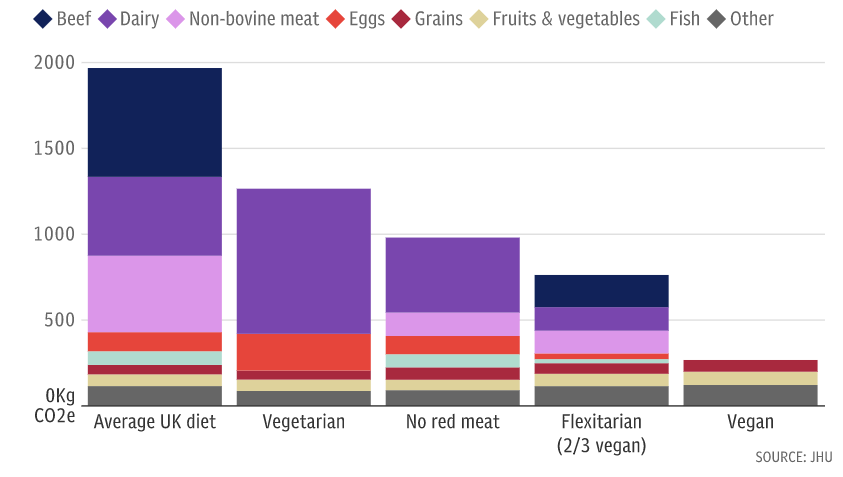
JHU- John Hopkins University (Baltimore USA), Note- Flexitarian consumes 1 portion of meat a day

However in practise these numbers are taking into account the consummation of the same sourced food and therefore as we have seen can be unrealistic. This data requires people to eat local, sustainably sourced food. A seen by this article, that would be a perfect way to know that you are bettering the environment. One cannot simply drop meat from their diet and assume they are doing good, or choose veganism as a cool new trend, as these can be seen as having the adverse effect that anticipated. The argument to go vegan or not is still creating debate in the media, with conflicting information and old information still very much in the mainstream (articles on Quinoa for example were notably older than that of Almond). With so much of this topic based on opinion it’s important to know that research is key, reading conflicting articles helps you to pick out the facts from the emotive arguments.

The Opinion Section

Hopefully this article shows you guys a trend, a trend that suggest Sustainability comes not only from what we eat but also where we got it from and who made it. If you are concerned about the environment and want to change your diet and want to help make a change I would recommend buying local. British seasonal food is well sourced and the food miles are extremely limited. This will cost you more but will do double to help the environment and put money back into the local economy. There is more to this issue than meets the eye. With the current issues this world is facing a sustainable country will be hard to find if we continuously look abroad for food; to be sustainable your nation has to be self sufficient to a certain extent. The modern cheap supermarkets help individuals save money, but the nation as a whole loses out, so there is a larger issue to be had in that regard. At the end of the day research is the most important and with the world ever changing things that were once a good alternative may in fact become bad. I myself have no intention of becoming vegan or vegetarian as I believe in a balanced diet; I don’t eat meat all the time but i still eat it nonetheless.

Thank you for reading!

Suggest a new topic at: Billy.duff@outlook.com or on Twitter: @OpinionatorNews

America And Iran – Exploring The Facts.

In the past week actions taken by the USA and Iran have fired tensions with long historic issues. Modern media hasn’t touched on many of these issues, so that’s where I come in, let’s delve deeper into these issue and explore what’s exactly going on between America and Iran.

The History Part 1: 1941-1979

We start by focusing on Iran; more specifically on Iran’s leader after World War 2. Mohammed Reza Pahlavi also known as the Shah (emperor) controlled Iran from 1941-1979. He is key to the start of this issue as he was installed by military intervention for the Soviets and the UK during Wold War 2 and was backed by the West during the cold war. The Shah’s link and backing by America was key for the US, as it allowed them further support in the region, access to oil fields, and the friendly relations upheld between Iran and Israel. In 1953 the US and UK cemented their influence in the region after assisting the Shah in a coup against then president Mohammad Mosaddegh, who had earlier been in a power struggle with the Shah and the Anglo-Iranian oil Company. Using UK and US Spy networks Mosaddegh was deposed in a military coup, allowing the Shah to extend his power from a constitutional to absolute monarchy; This created anti-Shah and anti-American sentiments within the Iranian working class. Furthermore, anti-American and anti-Shah tensions would further be heightened in 1977, as President Carter further alienated the Iranian people.

Carter considered Shah Mohammed Reza Pahlavi an ally and friend. In December 1977, he visited Tehran and toasted the shah for making Iran “an island of stability” and for “the admiration and love which your people give you.” It was a delusional toast, one that demonstrated a total lack of understanding of historical legacies and the political fires raging in Iran.

Peter L Hahn
https://www.washingtonpost.com/news/made-by-history/wp/2017/10/22/how-jimmy-carter-lost-iran/

These events would contribute to the Shah’s downfall, as well as his policy’s of modernisation, friendship with Israel and his hostility towards the growing left population. . After months of civil unrest the Shah departed in January and an interim revolutionary government was set up headed by Prime Minister Mehdi Bazargan, the US secretly backed the return of Ayatollah Khomeini from France in 1979.

Shah Mohammed Reza (left) and President Nixon(right) (1969) from: https://www.pinterest.co.uk/pin/139189444703675260/?lp=true

The History Part 2: 1979-1980

The Anglo-American intervention in the Shah’s regime had caused resentment from Iranian people, and in October 1979 this was intensified as the US allowed the Shah to enter the United States for medical treatment. This angered the revolutionaries and caused them to fear the return of the Shah to Iran. This heightened the rhetoric of the Ayatollah, who referred to the US as “Great Satan”(This is important to note, as Iran see the war against America as a holy war and as a devout religious nation, they are driven by this hatred as seen in recent days). On November the 4th 1979 Iranians loyal to Khomeini stormed the US embassy in Tehran, capturing the marines and staff; then holding them hostage. This led to a disastrous attempt from the American’s to rescue the hostages, this became an international embarrassment from President Carter’s presidency. Following these events anti-Americanism grew even stronger in Iran, strengthened by American support for Iraq after Saddam Hussein’s invasion of Iran turned against him. As we can see tensions have been high between the 2 states since 1979. Tensions were left to simmer until the events of January 3rd 2020 bought this topic back into the eyes of the media.

The Anglo-American intervention in the Shah’s regime had caused resentment from Iranian people, and in October 1979 this was intensified as the US allowed the Shah to enter the United States for medical treatment. This angered the revolutionaries and caused them to fear the return of the Shah to Iran. This heightened the rhetoric of the Ayatollah, who referred to the US as “Great Satan”(This is important to note, as Iran see the war against America as a holy war and as a devout religious nation, they are riven by this hatred as seen in recent days). On November the 4th 1979 Iranians loyal to Khomeini stormed the US embassy in Tehran, capturing the marines and staff; then holding them hostage. This led to a disastrous attempt from the American’s to rescue the hostages, this became an international embarrassment from President Carter’s presidency. Following these events anti-Americanism grew even stronger in Iran, strengthened by American support for Iraq after Saddam Hussein’s invasion of Iran turned against him. As we can see tensions have been high between the 2 states since 1979. Tensions were left to simmer until the events of January 3rd 2020 bought this topic back into the eyes of the media.

The Issue Today: The Mainstream View

On January the 3rd an American airstrike targeted and killed Iranian general Qasem Soleimani near Baghdad in an unexpected airstrike. The media quickly picked up the story informing the population who at the time were none the wiser to who this man and his actions. One thing however is quite striking about these media posts and videos; their information varied and changed as, to be frank, no one in the media quite knows the truth behind what Soleimani has done.

In his decades-long career at the helm of the Quds Force, the unit of Iran’s Revolutionary Guards responsible for directing Iran’s unconventional conflicts abroad (think Syria, Yemen and Iraq over the last two decades), General Soleimani was responsible for countless deaths, including those of Iraqis, Americans, Syrians and Iranians to name a few. Soleimani posed a direct and ongoing threat to civilians across the Middle East, as well as to American personnel in Iraq and elsewhere. What is more, he perpetrated his crimes in the manner of a common terrorist; that he has died like one is only fitting.

 Giulio Terzi di Sant’Agata
https://www.euronews.com/2020/01/04/was-soleimani-s-killing-justified-yes-a-million-times-yes-view

“We took action last night to stop a war, we did not take action to start a war.” “Soleimani made the death of innocent people his sick passion, contributing to terror plots as far away as New Delhi and London. His reign of terror is over.” “He was plotting imminent and sinister attacks on American diplomats and and personnel but we caught him in the act and terminated him.”

Donald Trump

Pentagon said Gen. Qassem Soleimani was “actively developing” plans to kill American diplomats and service members when he was killed in a U.S. drone strike Friday near the Baghdad airport shortly after arriving in the country.

Ben Fox
https://www.washingtonpost.com/world/national-security/legal-basis-for-us-killing-of-iran-general-depends-on-threat/2020/01/03/17509eb2-2e4b-11ea-bffe-020c88b3f120_story.html

As a reaction to this we have no evidence that we can either confirm nor deny the truth to the US’ claim that Soleimani was planning an attack. Thus America’s justification of the attack is neither true nor false.

However within this paragraph I will make the case for why he is not a terrorist. The following paragraph is not fact, this is simply my personal opinion. I believe that the word terrorist is quickly becoming overused in today’s society, the word is swiftly losing meaning and is becoming an easy way to label your enemies; however, let’s go back to basics and look into this. He isn’t a terrorist as he is not killing people for the very reason terrorists kill people; political motivations. I will also make this point very clear; This man was not a good, nice or innocent man, he is evil and sadistic. However, let me put one simple point across to you; if I am a general for an army, and I give orders that lead to the death of innocent people, does that make me a terrorist, the answer is no. That action would make me a war criminal. War criminals (if you are unaware) are tried in court (even Nazi’s) therefore this is an improper action and If we label him as the war criminal he is, then blowing him up like that is murder and also a war crime. Say however you feed into the narrative he is a terrorist, well for a start he has ordered the death of around 600 US military personnel in an active war zone (although actual statistics claim the number is a lot less, around 100; there is nothing wrong with that, if your enemy kills you in an armed situations that is not unlawful. If you use the argument following that by saying that there is no war going on against Iran/Iranian proxies, I will leave you with the question, so why are American’s fighting them? Furthermore, the man has used criminal tactics to win battles, that is correct and has killed thousands of civilians directly because of unlawful action, this still does not make him a terrorist. We have to be able to judge that this man is evil without placing labels on him such as this. The problem with this is that the USA has done the same thing in the same war, The USA and Coalition has killed in Syria and Iraq an approximation of 10,000 civilians by both air and ground troops (source: The Iraq Body Count project (IBC) documented a higher number of civilian deaths up to the end of the major combat phase (May 1, 2003). In a 2005 report,[87] using updated information, the IBC reported that 7,299 civilians are documented to have been killed, primarily by U.S. air and ground forces. (https://en.wikipedia.org/wiki/Casualties_of_the_Iraq_War#Additional_statistics_for_the_Iraq_War) and international Coalition Forces 3,037 (https://en.wikipedia.org/wiki/Casualties_of_the_Syrian_Civil_War#Civilian_deaths)) , so keeping up standard, all those US and Coalition soldiers and personnel that are responsible for these high levels of fatalities are also terrorists, but no, these members of American and other Coalition forces that killed civilians willingly are tried as war criminals, and rightly so. The USA’s labelling of this man as a terrorist can arguably be a sign of pro US propaganda, rather than actual fact.

Now let’s look and some other possible motives behind the recent events and evaluate them, these are in no particular order.

Number 1: The Israel Link

Under the Trump administration the bond between Israel and the US has grown stronger, with Trump taking a pro-Israel stance in contentious foreign affairs (like recognising Jerusalem as the capital of Israel). This is critical to US thinking in the middle east, as Iran’s anti-Zionist agenda and ties to Hezbollah have posed a threat to Israel’s power in the region. This would have made Soleimani a target for America; as Soleimani was an organiser of Iranian proxies in the Middle East, he posed a threat to Israeli security and so therefore was a target to America.

Israel knew, UK didn’t: Benjamin Netanyahu ‘was warned by the US of its plans to kill Qassem Soleimani ahead of the drone strike’

Jack Newman
https://www.dailymail.co.uk/news/article-7851877/Benjamin-Netanyahu-warned-plans-kill-Qassem-Soleimani-ahead-drone-strike.html

The fact that Israel knew before Britain suggests the nature of this issue was different to the usual security posed by so called ‘terrorists’. It is entirely possible that America had received intelligence surrounding a threat to Israeli assets in the area.

Number 2: The Saudi Link

A perhaps more obscure link and harder to find evidence for is the link between The US (specifically Trump) and Saudi Arabia. Some of you may not know that the series of proxy conflicts between Saudi Arabia and Iran have been dubbed the ‘new Cold War’ (https://www.aljazeera.com/indepth/opinion/2012/11/2012111311424048459.html). This is important to know as the actions taken in escalating the Yemeni civil war by Iran in 2019 would have caused more worry to the Saudi government. The Saudi link works like so: America aid Saudi in taking down a target that is causing issue for them in the area (as well as causing issue for the US, kind of a 2 birds 1 stone situation). This benefits the US as they secure oil fields in the area in Iraq and Saudi Arabia, thus allow them to keep business with the nations. This benefits Trump as one of his major backers is from Saudi Arabia, and is known to have passed money onto Trump through his hotel businesses. This further helps Trump as successful foreign policy is known to boost approval rating and support, so with the election coming up, the attack is well timed to help Trump win re-election. This link is purely speculation, however a possibility nonetheless.

In summary, these tensions don’t seem to be going away under the current Republican policy in America. There is an argument to suggest however, that if a non-interventionist Democrat was to win in 2020 we could see a change in policy. Iran’s anger towards the US created during the cold war is at boiling point, but can be cooled by actions taken to avoid conflicts. In this situation I personally advocate for a non-interventionist approach in the Middle East, as previous actions have caused more harm than good.

Thank you for reading!

Suggest a new topic at: Billy.duff@outlook.com or on Twitter: @OpinionatorNews